
Walk through the gate and say hello. That's the whole post, really. It costs nothing, it takes a second, and it changes the shape of the day for the person you said it to. And every season a few athletes slide past their coach, their teammates, and a dock full of parents without a word, or with a small, peeped-out "hi" aimed somewhere at the ground. This is about the difference between those two things, and why the difference follows you all the way to the start line.
Say it like you mean it
A real hello has three parts. You look the person in the eye. You use their name if you know it. And you say it boldly and on purpose, loud enough to be heard the first time. "Morning, Coach." "Hi, Mrs. Ortiz." "Hey, Sam."
There's no trick beyond the courage to do it plainly, and it does take a little courage, especially at fourteen, especially at 5:45 in the morning. Do it anyway. Then, when a hello comes your way, turn around and give it back with the same weight. A greeting is a pass, not a shot; it only counts if someone catches it.
Better still, add a question. "How was your day?" "How are things going?" You'll be surprised how often the answer is interesting, and how differently a practice runs when the people in it have actually looked at each other before the first stroke. And at the other end of the session, the same manners in reverse: goodbye, and thank you for the practice.
Everyone gets one
Your coach, your crewmates, the parent who drove someone else's kid, the sibling waiting in the car. All of them. It is essential to look a coach and a parent in the eye, address them, and greet them. Not because they need it, but because acknowledging the people around you is basic decency, and a team that greets each other is a team that talks to each other, in the boat and out of it.
That includes the people who run the marina. Chris, Joe, Ernest and the rest of the crew there look out for our gear all year. They check the straps when a storm is coming. They pick up the water bottle you left on the dock and put it somewhere safe. They ask how you did on Saturday. It takes nothing to look them in the eye, wave, and say hello, and it means more than you think.
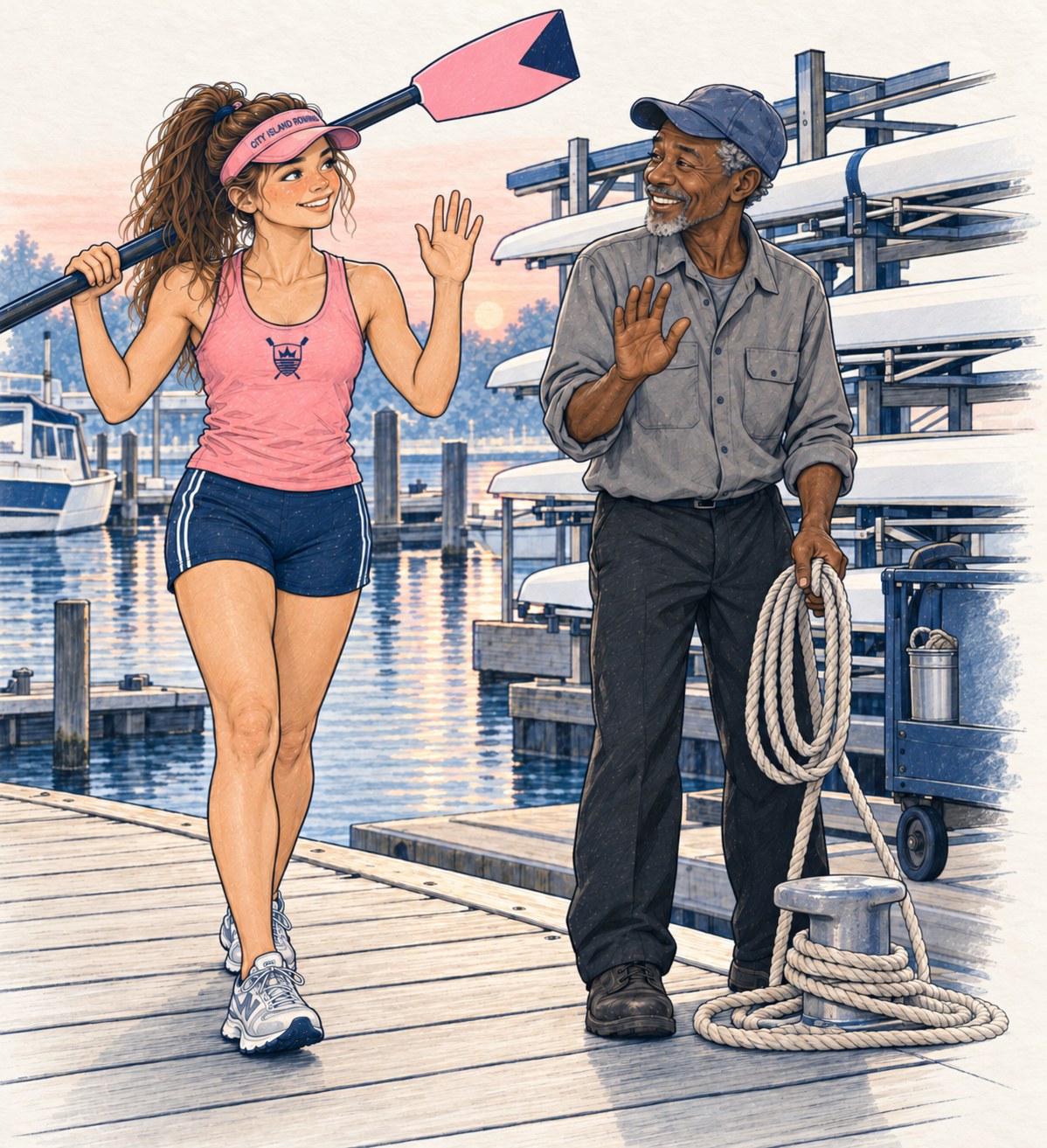
The marina crew mind our boats all year.
They get a hello too.
The launch dock
Here is where hello turns into something with real consequences.
At a regatta, before you launch, you take the boat to the dock official for inspection. Don't stand there waiting to be asked. Walk up, look them in the eye, and give them what they need in one breath:
"Good morning. City Island Rowing, event 22, heat 1, lane 6."
Club, event, heat, lane. They'll check your bow ball, your heel ties, your bow number, and release you. When they do, look them in the eye again. "Thank you, sir." "Thank you, ma'am." And go.
You will be remembered, because almost nobody does this. Those officials are volunteers. They've given up their Saturday to stand on a dock for eight hours so that we can race, and they're dealing with four hundred boats, most of which arrive as a sullen crew staring at their feet while the official drags the event number out of them one word at a time. A crew that arrives ready, knows its race, and greets them properly is a relief. It gets noticed.
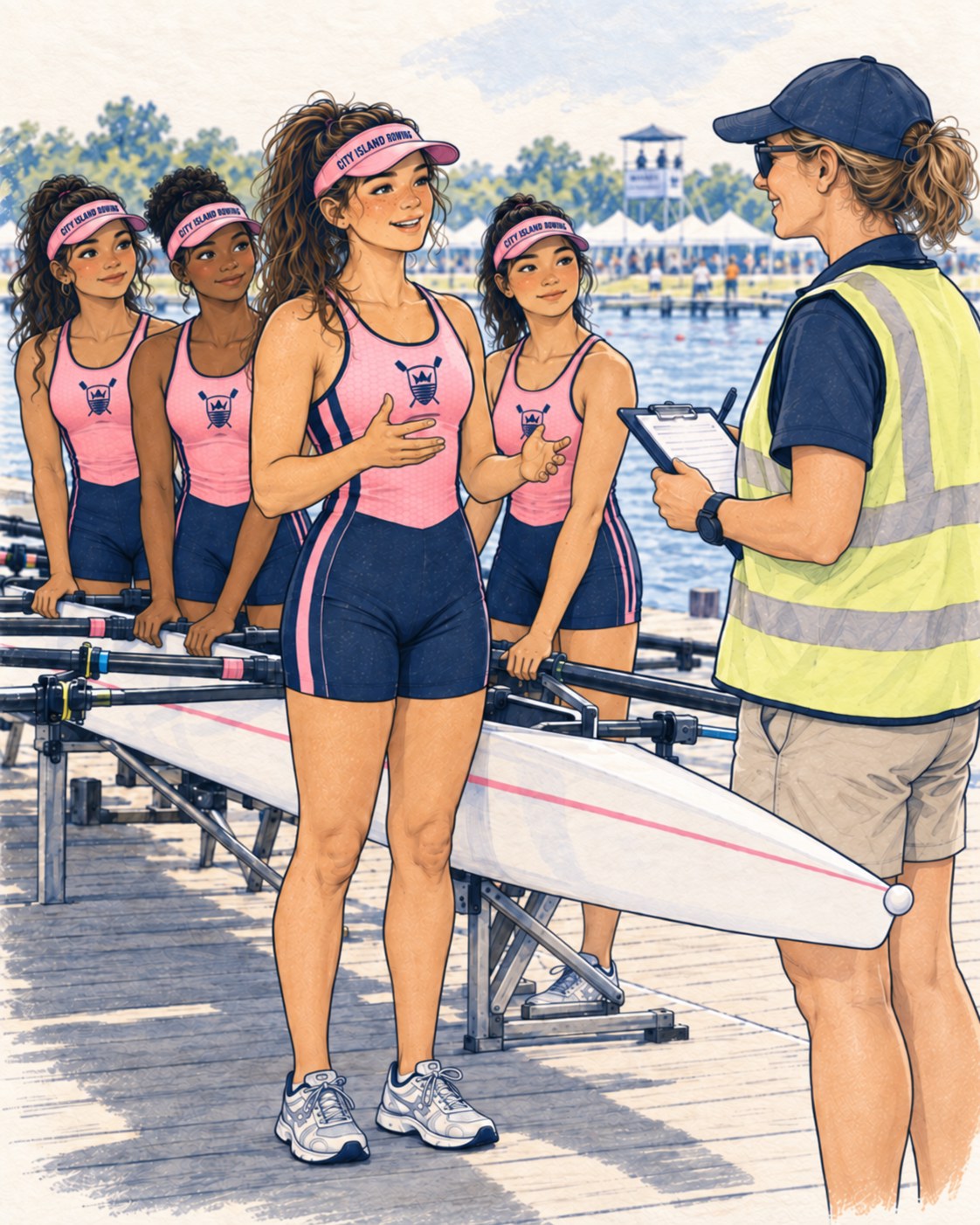
Club, event, heat, lane. Then thank you.
What the officials say about you
I'll tell you what happens, because it happens most regattas. At some point in the afternoon an official comes and finds me and says some version of this: "I just want to let you know, your girls are incredible. They arrive with the boat fully ready. We never have to adjust anything. They're attentive, they're engaging, they know what's going on. They're such a pleasure. We love City Island Rowing."
That's you. That reputation was built one hello at a time, by the athletes who came before you and by the ones standing next to you now.
When something goes wrong
Regattas are chaos held together with string. Sooner or later something goes wrong for us: a late trailer, a broken rigger, a heat that moved while we were on the water. In that moment we may need the smallest accommodation. A few minutes. A second look.
An official has two choices. The easy one is "sorry, you'll have to scratch," or "you've missed it." The harder one is to make it work. When the crew asking is one that has been courteous and engaged all day, every day, for years, the official already wants to make it work. They will bend over backwards for a club they like. Courtesy isn't a tactic. It's simply the reason the door opens when we need it to.
The PA tent
And then there's the tent. Your parents, and everyone else's, drove up before dawn to watch you race. They put up the tent, hauled the coolers, cooked up a storm, and they'll stand there all day in whatever weather turns up, all of it to support you. Every one of them gets a huge hello on the way in and a thank you on the way out. I challenge you to try to run out of hellos and thank-yous at a regatta. You can't.
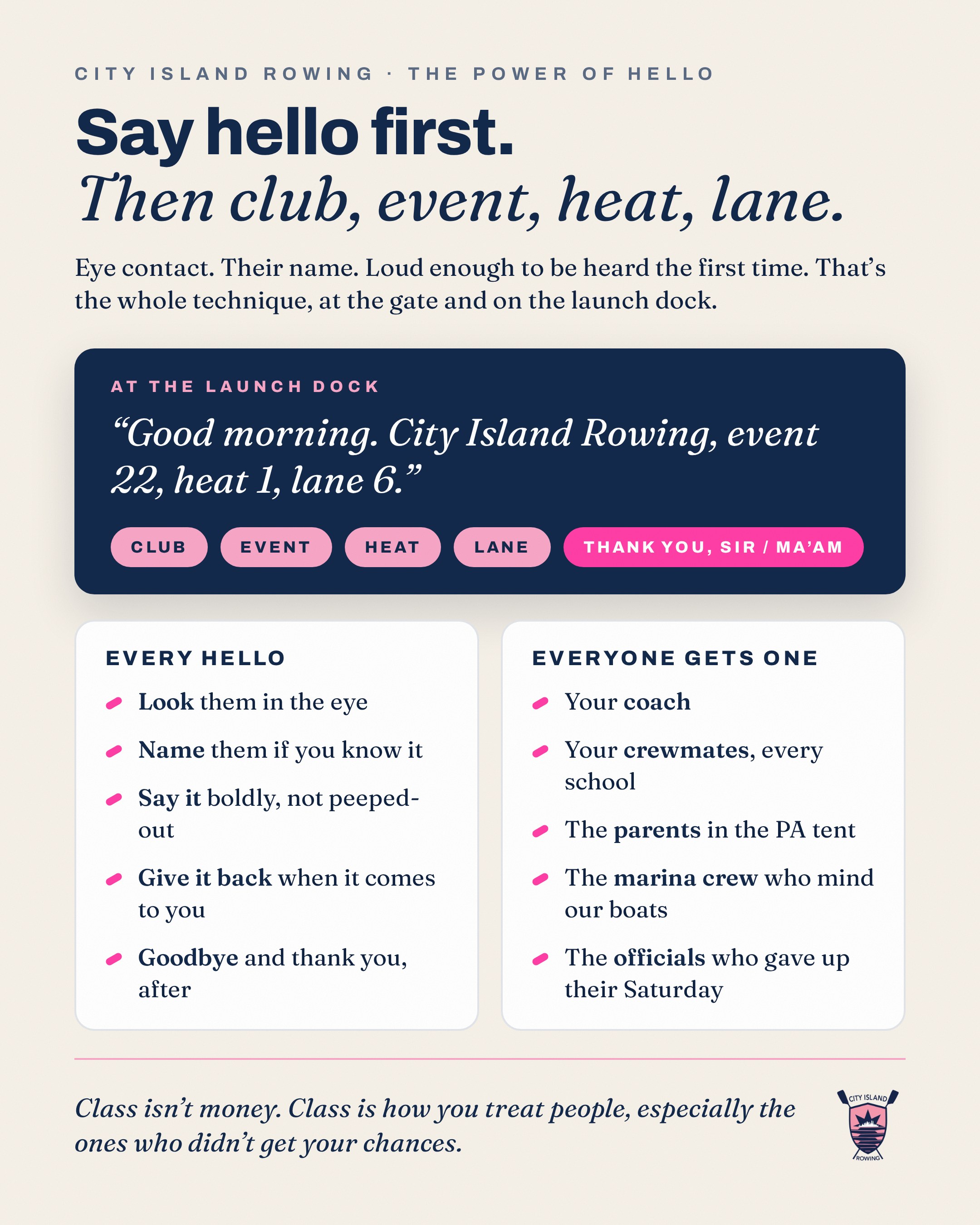
The launch-dock script. Save it for race day.
It doesn't stop at the gate
Take this with you. From your first job interview to the first team you work on, people notice who acknowledges the people around them, and those are the ones who get asked to lead, because they're engaging and they include people. That's what inclusion actually is: not something you say, something you do at the gate at 5:45 in the morning.
And it's not just coaches and teammates. The barista, the clerk at the grocery store, the mailman, the waitress. Do you make eye contact? Do you say hello and speak to them clearly? Or do you mumble at the counter and expect miracles? People think class is about money. It isn't. Class is how you treat other people, especially the ones who didn't get the same chances you did.
Look people in the eye. Say hello like you mean it, use their name, and give it back when it comes to you. Thank the people who ran your practice and the people who ran your race. At the launch dock: club, event, heat, lane, thank you. It costs nothing, and it is worth more than you can possibly know.
Say hello first.