A small club runs on its families. Here's what to expect, how the year works, and how to help — without it taking over your life.
We row from City Island in the Bronx — Long Island Sound to the east, Eastchester Bay to the west, and the calmest evening water in New York. Manhattan and Westchester families both make it work; carpools are the club's circulatory system.
Fall brings day trips (New Jersey, Port Washington, our own Halloween Throwdown) and two overnights — Schenectady and Saratoga — with a team hotel block — families and athletes stay at the same hotel. Details for each trip arrive by email well in advance.
Everything about race days lives on the Regatta Guide — every venue, address, and official website — with the what-to-pack and how-to-spectate wisdom on the Tips page. Bookmark both before your first regatta.
The Boathouse team shop is open 9/1–9/5 only (splash jacket is the essential; it's navy, not black). Racing uni orders close 9/5. Everyday CIR merch runs year-round on SquadLocker. All ordering links and forms live on the Fall Master Spreadsheet, emailed to families.
Athlete safety is the number one priority at City Island Rowing: please read our SafeSport page. And there is always paperwork to do: the annual waiver and medical release are required before an athlete can participate, and they live with everything else on the Documents page.
Spring is championship season. An athlete who travels during it hurts her crew's ability to train and perform — so take vacations at Thanksgiving, over the winter holiday break, and in the second half of February break. Summer rowing (6/21–8/8) is the best rowing of the year: row July, travel August.
Our corner of City Island is small, busy, and shared with working businesses and neighbors. It runs beautifully when every family follows the same few rules.
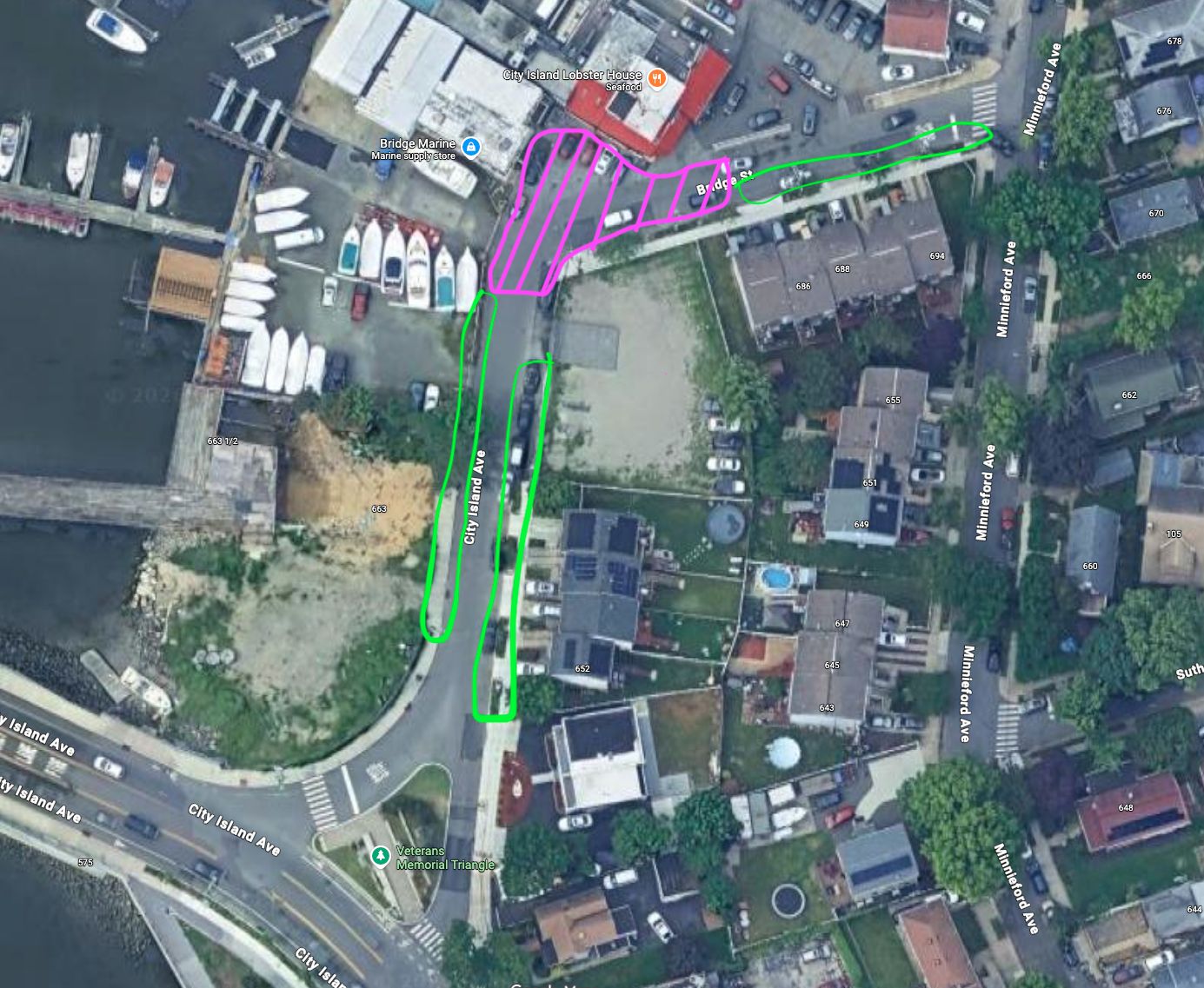
Pink zone: never. No parking and no live waiting in front of the marine supply store, at any time. Please respect their business.
Green zones: yes. Stop, wait, and park here, along with Minnieford Avenue and the nearby streets.
No turning around. Travel in one continuous direction. Either direction is fine; the corner is not a turnaround.
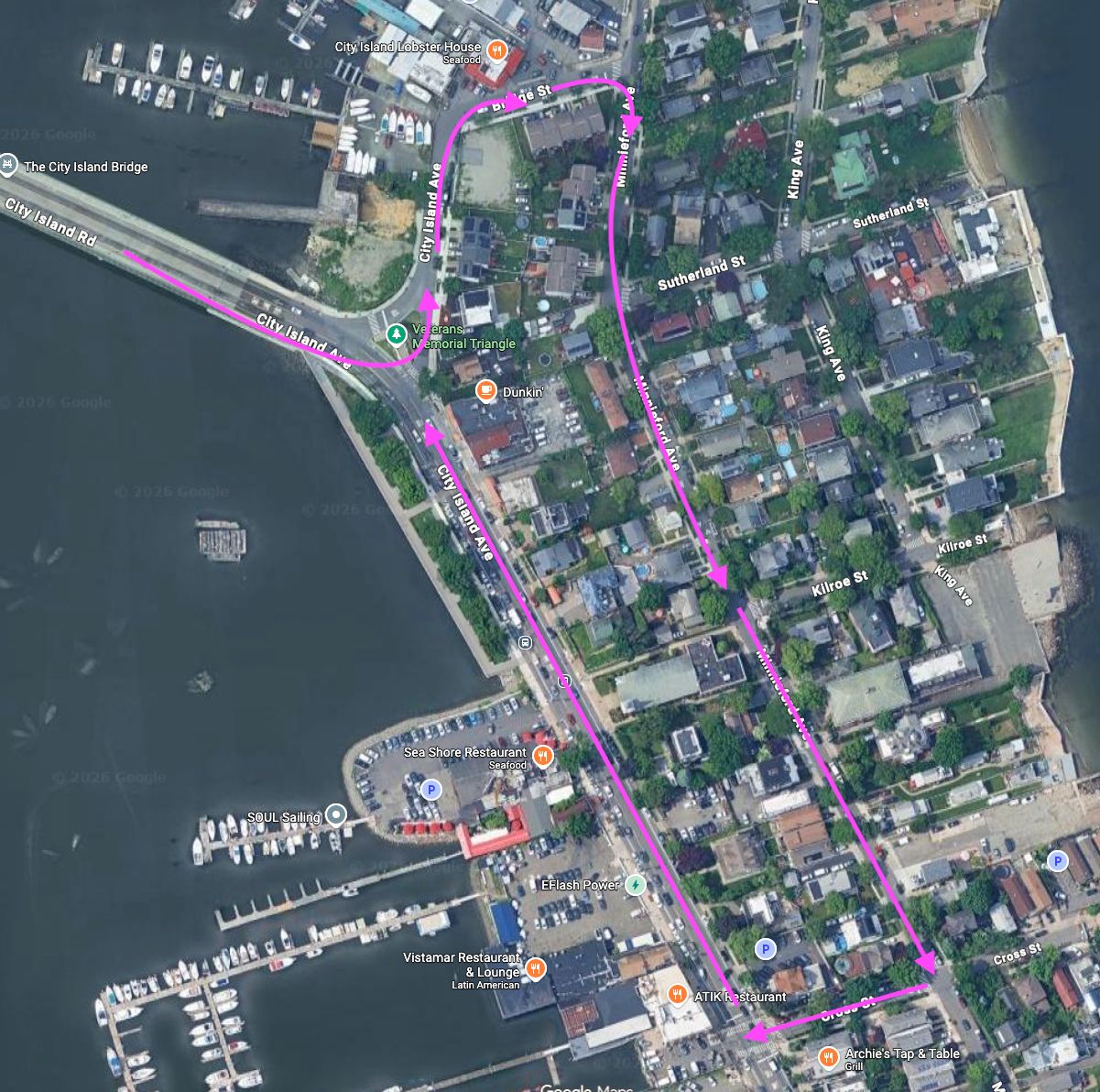
The easy loop: up the Avenue, out along Bridge St, down Minnieford, back on Cross St.
Lingering goodbyes happen 50 yards down the road, past the restaurant entrance. Your athlete can happily walk a hundred yards to meet you.
Boats get 90 seconds on the dock. Cars get 30 seconds at the stop.
Saturday mornings and Wednesday mornings have extra pressure: on Wednesdays, the corner spots belong to self-driving athletes who park for the whole practice, parked tight, far left first.

Temperatures drop remarkably fast once the sun goes down: athletes should dress for conditions 15 degrees colder than when they left the house. Always running shoes. A long sleeve shirt for on the water, and a dry layer waiting for after: sweatpants and a sweatshirt.
By mid October we row in the dark, and that is completely normal in the rowing world. There is tremendous lighting along the shorelines, eyes adapt quickly, and every boat and safety launch is very well lit. Rowers, especially new ones, often row better in the dark. Fewer distractions.
Hi-Viz season. A high-visibility outer layer is mandatory at practice: from Monday, September 21 for U16, and from Monday, October 19 for U17 and U19. No exceptions.
About $20 solves it. Here's a good example of the kind of thing: fluorescent, long sleeve, quick dry.

A new post every Sunday: injury prevention, fueling, mentality, and the habits that make young rowers fast and keep them healthy. Written for our athletes — and just as useful to anyone who loves one.
Blisters, protein, sore hips, the difference between tired and injured — it's the advice we give at the boathouse, written down so it survives the car ride home.
The NCAA limits college athletes to 20 hours of training a week. Some high school programs in this area train near or at that number — and, said plainly, that's absurd for a growing teenager. Your daughter is a person to be built, not a cog in someone's results machine.
We train about 12 hours a week, and we remain regionally and nationally competitive with crews that train 16 and 18 — qualifying boats for Youth Nationals year after year. We are not asking less of your daughter — we are asking better: precise technical work, purposeful erg pieces, planned recovery. Efficiency is a performance strategy that happens to be the healthy one, not the other way around.
The schedule is engineered to protect four things: schoolwork, family, physical health, and rest. The sports-medicine consensus is blunt about why: growing bodies need rest, and overtraining in adolescence is where overuse injuries — and burned-out athletes — are born.
A girl who is healthy, rested, and still in love with the sport at 18 outperforms one who peaked, hurt, at 15 — in racing, and in the recruiting process that follows it. The full philosophy →
“My daughter has rowed at CIR for three years after trying out a different local club. CIR is an all girls club, and is smaller and doesn’t feel like a factory like so many other clubs do. What sets CIR apart is the emphasis on the whole girl — athleticism and strength, good health, teamwork and camaraderie. It has been an incredible community for our daughter and for us. If you or your daughter is interested in rowing, this is the place.”
— A CIR parent
City Island Rowing is a nonprofit governed by a parent board.
| President | Chris Renzulli |
| Vice President | Patrick Convery |
| Treasurer | Chris Croft |
| Secretary | Maura McDonagh |
| Member at Large | Amy Pisano |
| Head Coach | Guy Monseair |
| Parent Assoc. Chairs | Nicole Tuck · Toby Leddy |
| SafeSport Officer | Kristen Renzulli |
| Novice Parent Liaison | Jenn Caiola |
Questions of any kind: [email protected].