
The results go up, and the first thing everyone looks for is the place. Then the time. Then the phone goes back in the pocket and the verdict is in: good day or bad day.
Both of those numbers are real, and neither of them tells you much. A head race result is a story, and the place and the time are the last page. This is how to read the rest of it, and how a new tool for athletes, parents and coaches lays it all out for you.
The place tells you who showed up
Twelfth out of forty is a different result from third out of five, and a crew can finish twelfth one year and sixth the next without getting any faster. The place is a sentence about the field, not about you. It is the number that travels worst from race to race, which makes it the worst number to build a season's confidence on, in either direction.
The time tells you about the river
Your raw time belongs to that day. Current, wind, water temperature, the traffic you met at the bridges. The same crew on the same course can be forty seconds apart on two consecutive weekends without a stroke changing. Never compare a time across years, or across courses, and never compare it to a crew that raced in a different hour of the day. The weather moves; the number moves with it.
Seconds behind the winner
The first useful number. Take the winner's time away from yours. Everyone in your event rowed the same water in roughly the same hour, so the gap is the day's conditions cancelled out.
Then take one more step, and divide the gap by the winner's time. That gives you percent behind, and percent behind is the currency that travels. It works across events, across years, across courses, across boat classes. At the Head of the Charles, for a youth eight, one percent is about ten seconds. Inside two percent you are in the conversation. Five percent is a different race. A crew that goes from seven percent back to four percent back has had a very good year, whatever the place says.
The gates are where the race happened
The big regattas publish intermediate times at fixed points on the course. On the Charles there are three on the way to the finish, at Riverside, at Weld and at the Cambridge Boat Club, which makes four legs. Most people never look at them. They are the whole story.
Read each leg as elapsed time, how long you took from one gate to the next, and put it beside the winner's. Now you can see the race.
Lost most of it in the first leg, held level after that: you went off at the wrong pace, or the start was a mess. Fixable with discipline.
Level through three legs, lost it in the last: fitness or fuel. Also fixable, but in the gym and at breakfast, not on the water.
Lost it on the legs with the turns: the line, or the crew's ability to hold rhythm through a turn. Different work again.
Lost the same amount on every leg: you are simply a slower boat right now, which is the most honest result of all, and the easiest to train.
The gates also rank you. Look at the card below: nineteenth at Riverside, fourteenth at Weld, tenth at the Cambridge Boat Club, ninth at the line, and the fastest leg of the race was the last one. Rowers call that negative splitting: faster, and higher, every leg. Another crew can finish ninth having sat ninth from the first gate, or having faded from fifth. Same place, three completely different races.
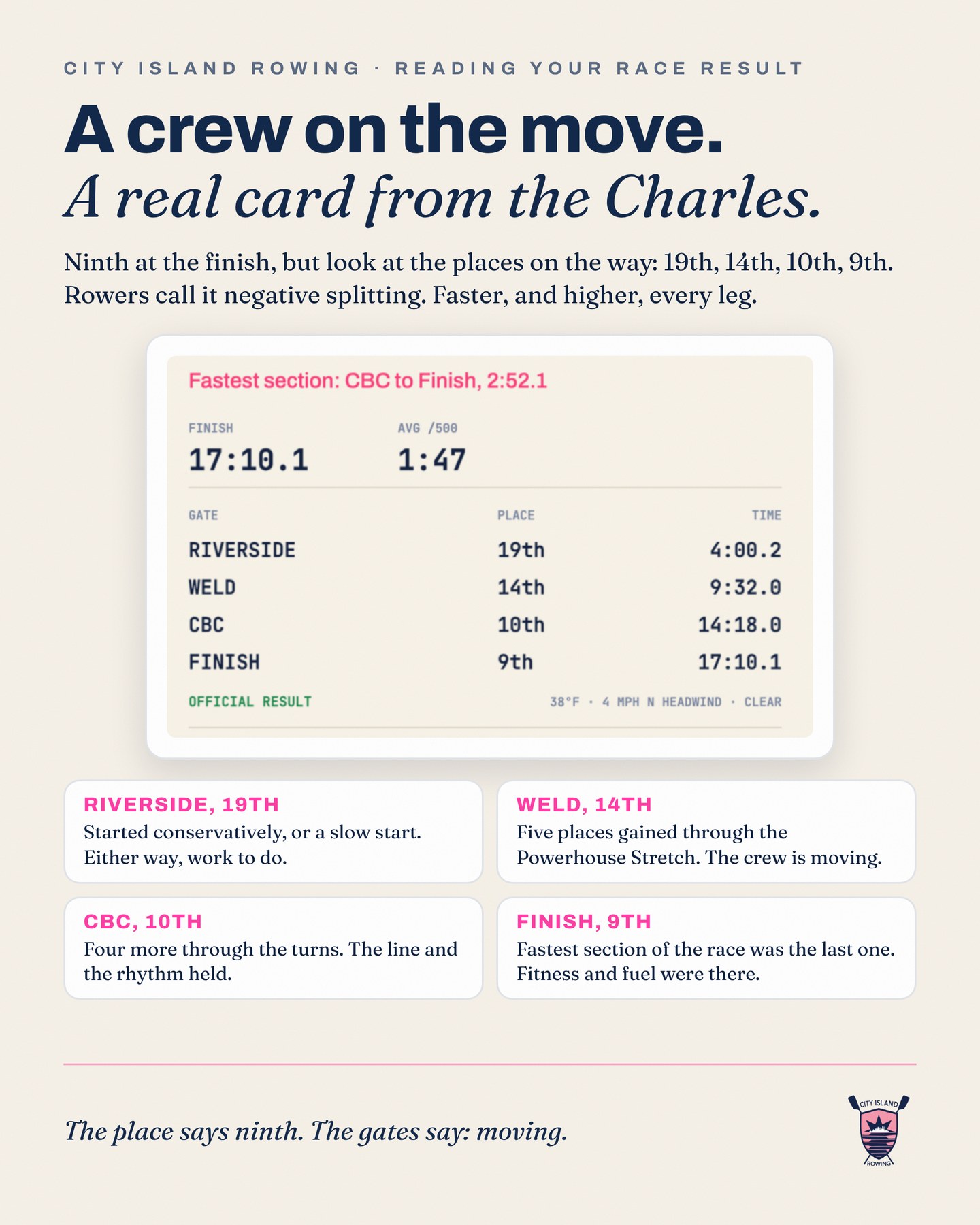
A real card from the Charles.
The place says ninth. The gates say: moving.
Your target is not the winner
In any event, nobody rows every leg fastest. The crew that wins the first leg is often not the crew that wins the race. Look at the fastest time through each leg across your event and you will see what was possible on that water on that day, leg by leg. That is the target. It is a more useful ambition than the winner's total, because the winner's total hides the leg where even the winner was slow.
The only fair comparison
You, on the same course, in the same event, in another year, as a percent behind the winner. Nothing else is fair. Not your sister team, not last year's raw time, not the crew with four trailers.
A good program keeps that number season by season. It is a straight line of truth through all the noise of places and conditions, and it is the number a coach is actually watching when the lineups and the river have done their worst.
A new tool that does all of this
Until now, reading a result like this meant a spreadsheet and an evening. This fall there is a free, web-based tool that does the work for you: Gate to Gate, at gatetogaterowing.com. Type your club or your bow number for any crew at the Charles and it gives you a result card with your time, your seconds behind the winner and your place at every gate, plus the field going back several years, so you can see your own line of truth. The Head of the Fish, the Schuylkill, the Hooch and the Princeton Chase are on it too.
It is the place to go when you want to understand a result rather than just get one. Read it with your crew. Read it with your coach. The card is the thing you post; the page underneath it is the thing you study.
Replay: watch how it happened
The gates tell you where you lost ground. Replay shows you how. When two or more crews in a race have a GPS line, from a posted file or from a phone tracking live in the boat, Replay starts them together and runs the race side by side on the course, each crew on the line its coxswain actually steered. At any moment you can see every crew's split and stroke rate, who is pulling away and who is fading, and how far each line wandered from the shortest one.
In the frame below, five and a half minutes into a race, the navy crew is holding 1:52 at 33 on an aggressive line, tight to the inside of the S-turn. The pink crew swung wide through the bend and is crossing the gate at 1:55: the line is costing them, and you can see exactly where. The gold crew is well behind at 1:58 on a safe line, and nothing in the picture says they did anything wrong. They may be a younger crew, a smaller crew, a crew still developing, and that is fine. Not every gap has a fault behind it. Sometimes a crew is simply slower today, and that can be a result to be proud of or disappointed by, but it is not a mistake. Replay tells you which kind of gap you are looking at. That is the conversation to have on the bus home.
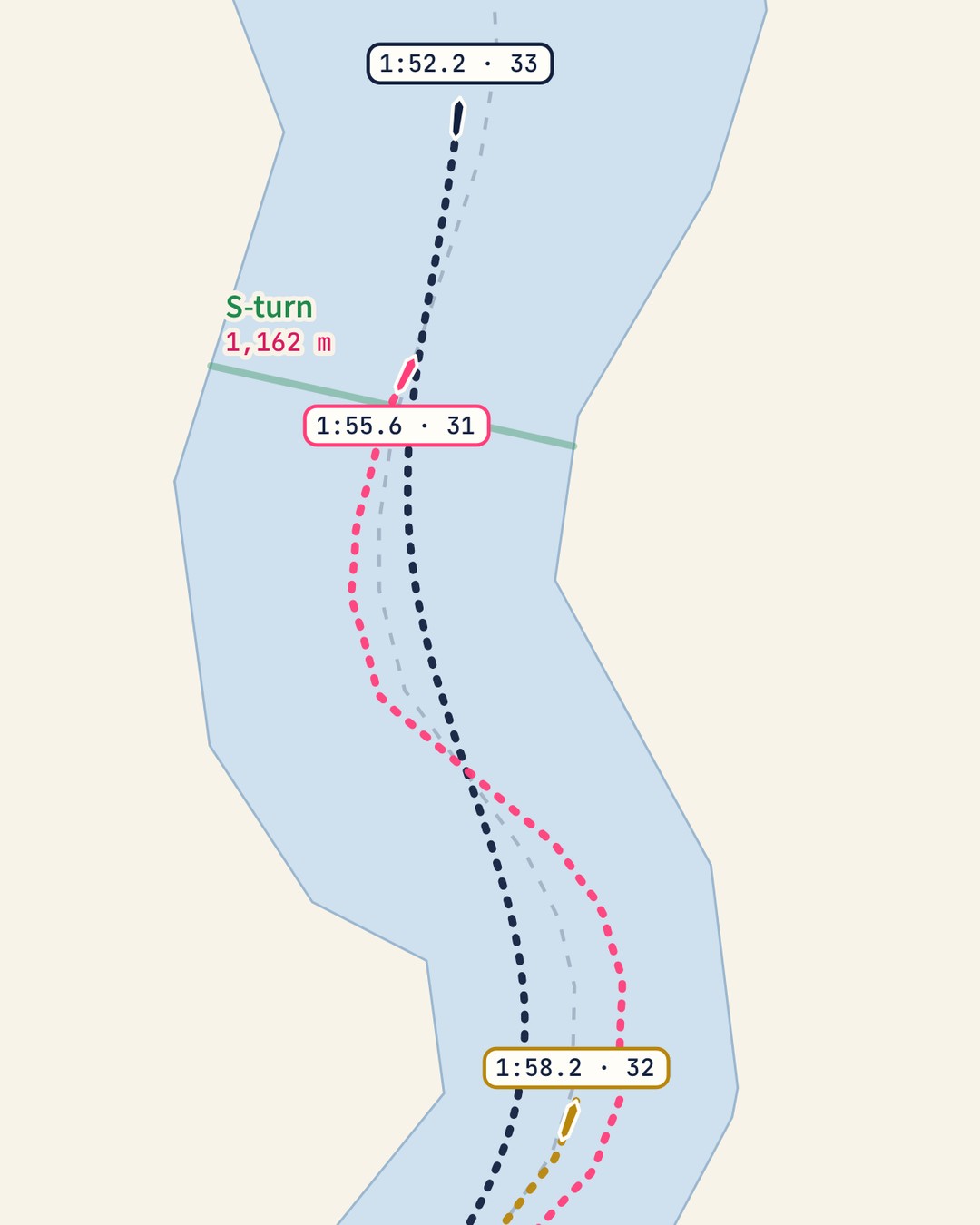
Replay.
Three lines, three splits, one turn.
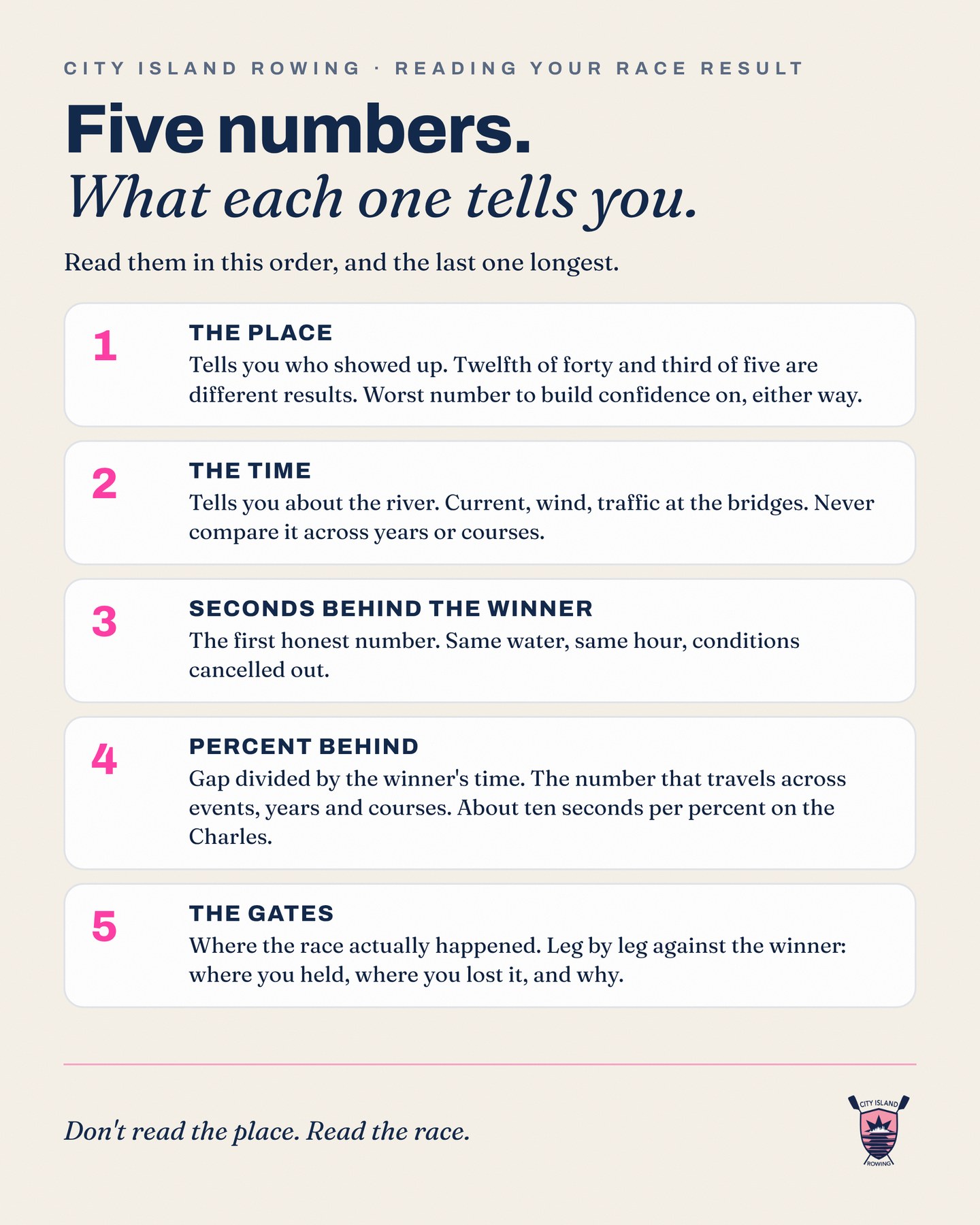
Five numbers.
Read them in this order, and the last one longest.
A word to parents
You will ask what place, and you should; she wants to tell you. The constructive questions come next, on the way home: where did you lose it, where did you gain, and what did you learn? If she can answer, she has read her race. If she can't, open the card together and read it with her. Percent behind the winner, leg by leg. Ten minutes, and the whole weekend turns from a verdict into a lesson.
And the sentence to retire for good: "You were so close to a medal." Close to a medal is a fact about the field. Two percent back and gaining is a fact about her.
The place tells you who turned up. The time tells you about the river. Seconds behind the winner is the first honest number, percent behind is the one that travels, and the gates are where the race was actually won and lost. Compare yourself to yourself, on the same course, year on year, and let everyone else argue about places.
Don't read the place. Read the race.